Here's something that confuses people about me.
At 10 AM on a Tuesday, I'm sitting cross-legged on my bed in Edinburgh, laptop warm on my thighs, writing a scene where a pizza delivery girl named Maria finally sleeps with the man she loves — and I describe every kiss on her neck with the precision of someone performing surgery on a butterfly. I want you to feel the warmth. I want you to blush. I want you to text your partner afterward, because something in your chest woke up.
By 10 PM, I'm in the studio screaming about eating a man's heart while it's still beating, over blast beats and industrial synths, and the only warmth in the room is the heat coming off the amp.
People hear both and ask: "Which one is the real you?"
Sweetheart. They both are. And that's not a contradiction — that's called being a whole person.
The Morning Version
Let me tell you about writing romance.

My series Unexpected Hearts is the softest thing I've ever made. It's warm. It's tender. The sex is explicit — I don't fade to black, I don't cut to the next morning, I describe exactly where his hands are and exactly what she feels — but it's wrapped in so much emotional context that by the time the clothes come off, you're not reading porn. You're watching two people finally trust each other enough to be naked. There's a difference.
In Pizza, Two Sauces, and Sex, Maria and Frederick use a condom in every single scene. Every one. Until the very last chapter, on their wedding night, when for the first time — they don't. And if you think that's just a logistical detail, you haven't been paying attention. That moment isn't about latex. It's about barriers. It's about the ones we build around ourselves and the ones we choose, deliberately and terrifyingly, to remove.
I cried writing that scene. Actual tears on my actual keyboard.
When I write romance, I access a part of myself that desperately believes in love. Not the Instagram kind. The kind where someone sees your worst and stays anyway. The kind where you can fall asleep mid-sentence and wake up with a blanket on you. The kind where vulnerability isn't weakness — it's the bravest thing you'll ever do.
That's not a performance. That belief lives in me. It has always lived in me — even when I was sixteen and the world was doing its best to beat it out.
The Evening Version
Now let me tell you about Devil's Darling.
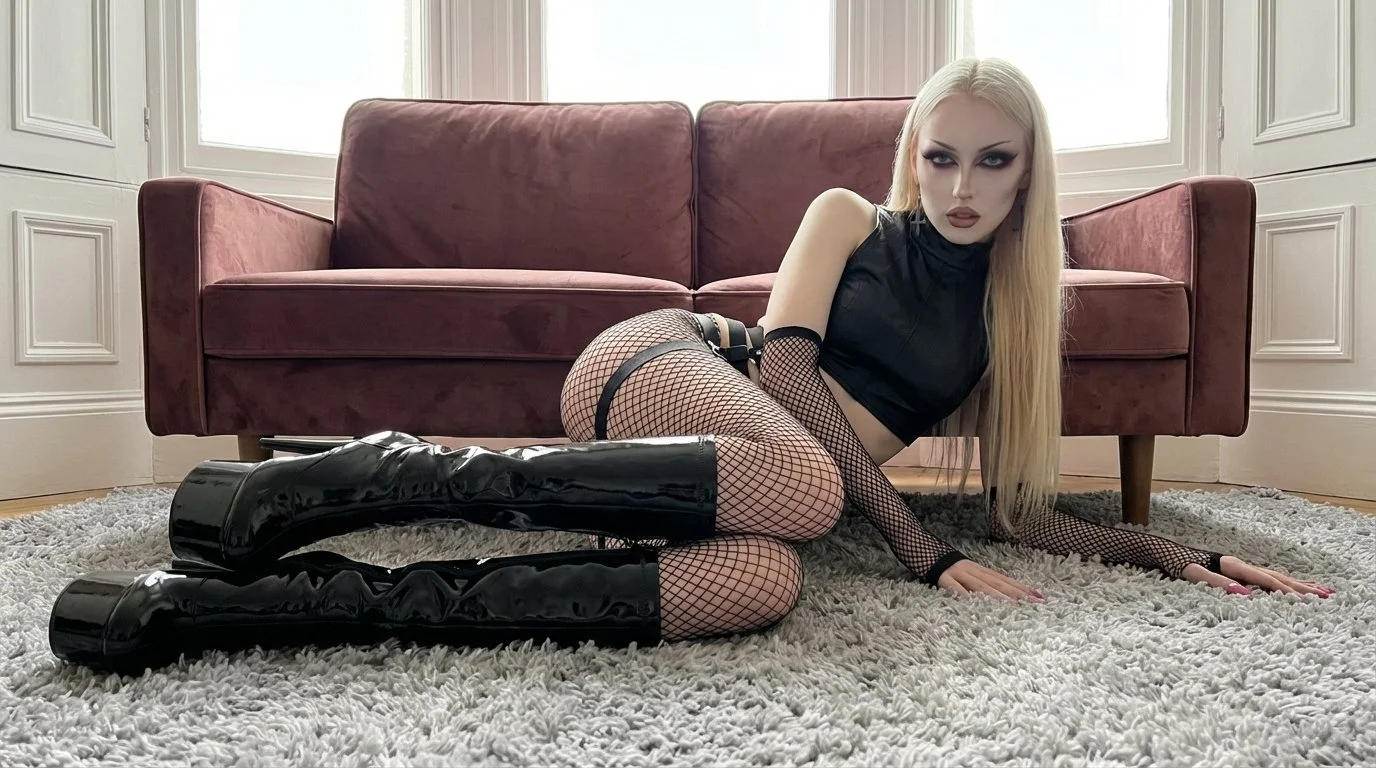
Track four is called "Paradise Profaned." It's a detailed, unapologetic depiction of sex in the Garden of Eden — not the sanitized, stained-glass version, but the raw, sweating, gasping version that the Church spent two thousand years trying to make you feel guilty about. Track eight is "Infernal Orgasm," and yes, there are actual moans woven into the industrial beat, and yes, I recorded them myself, and no, I will not be apologizing.
The whole album is structured as an anti-Bible. Genesis to Revelation. Eve takes the apple because she wants it. The Whore of Babylon isn't a villain — she's the freest woman in the story. And Satan isn't the enemy. Satan is the only one who said: "You're allowed to want things."
When I write music, I access a part of myself that is furious. Furious at every hand that tried to control my body. Furious at every voice that said "good girls don't." Furious at the equation I was taught before I could even name it: desire equals punishment, pleasure equals shame.
My music is the exorcism. Not of demons — of guilt.
That's not a performance either.
So How Do They Coexist?
Here's the thing people get wrong about contradictions: they assume one side must be the mask.
If I'm sweet in my novels, then the satanic metal must be an act — shock value, marketing, a costume I put on. Or if the darkness is real, then the romance must be ironic — a cash grab, a guilty pleasure I'm too smart to actually mean.
Wrong. On both counts.
I contain both because human beings contain both. You do too. You've held someone you love so gently you were afraid you'd break them, and you've also fantasized about things that would make your mother faint. You've cried at a sunset and laughed at a funeral. You've been kind and cruel in the same hour, sometimes to the same person, sometimes to yourself.
The only difference between me and most people is that I publish both sides under the same name and dare you to reconcile them.
The Technical Reality
There's actually a very boring, practical answer to "how do you switch between the two," and it's this: they use completely different creative muscles.
Writing a novel is slow. It's architectural. I outline, I draft, I revise, I agonize over whether "trembling" or "shaking" is the right word for how Emily's hands move when she reaches for the firefighter's face. A novel takes months. It requires patience, empathy, an almost maternal tenderness toward your characters. You have to love them. Even when they're being idiots. Especially then.
Writing a song lyric is fast. Violent. It comes out in one white-hot burst — twenty minutes, sometimes less — and it's done. The best ones arrive like lightning strikes: I hear a phrase in my head and I chase it until it's on paper. "Kiss the sole, lick the heel, suck until you choke" didn't go through seven drafts. It showed up fully formed, dressed in leather, and told me to write it down. I obeyed.
And here's the secret: the romance writing makes the music better, and the music makes the romance better.
Because when I've spent a morning writing tenderness, I arrive at the studio already emotionally open. The rage has a softer floor to crash against. It sounds bigger because there's more underneath it.
And when I've spent an evening screaming, I sit down to write the next chapter already emptied out. The anger has left the building. What remains is something unguarded and clean. The tenderness has more room.
They feed each other. They need each other. Remove one, and the other becomes a caricature.
What They Have in Common
More than you'd think.
Both my music and my novels are about the same thing: the right to feel without apology.
In Unexpected Hearts, my characters earn their happy endings by learning to be vulnerable. Maria has to stop pretending she doesn't care. Emily has to stop being invisible. The firefighter has to take off his armor — the emotional kind, not the fireproof kind. Love, in my books, is the reward for bravery.
In Devil's Darling, every song is about reclaiming something that was stolen. Eve reclaims her appetite. The Fallen Angel reclaims her body. The Whore of Babylon reclaims her name. Freedom, in my music, is the reward for rebellion.
Bravery and rebellion. Vulnerability and defiance. They're not opposites — they're dance partners.
It takes courage to scream "One by one they take me" on a record that your grandmother's friends might hear.
It takes exactly the same courage to write "I love you and I'm terrified" and mean every word.
The Personal Part
I'll be honest with you, because that's sort of my brand.
There was a time when only the darkness felt real. When I was fifteen, sixteen — angry, covered in acne, starving myself, listening to Rammstein through one earphone so my mother wouldn't hear — the only truth I knew was rage. Tenderness felt like a trap. Every time I'd been soft, someone had used it against me. So I built walls. Grew claws. Decided that if the world wanted a monster, I'd be the most beautiful monster it had ever seen.
The novels came later. They came from a different place — a place I didn't even know I had until I found safety. Until I landed in Edinburgh and the air was cold and clean and nobody knew my name. Until I realized I could be anyone. And the person I wanted to be wasn't just the girl with claws.
I wanted to be the girl who could write a wedding scene and mean it.
That girl had been hiding inside the monster the whole time. Waiting. Patient. Refusing to die no matter how many walls I built on top of her.
The Bottom Line

I am a woman who writes songs called "Apocalypse Whore" and "Infernal Orgasm" and "Daddy Satan."
I am also a woman who writes love stories where the condom scene is the most romantic moment in the book, where the hero's greatest act of courage is saying "I'm scared too," and where the happy ending isn't a fantasy — it's a thesis statement.
I don't owe the world consistency. I owe it honesty.
And honestly? I'm both of these women. The one who kneels at the altar of Satan and the one who kneels at the altar of love. The one who screams and the one who whispers. The one who will eat your heart out and the one who will hold it gently, like it's made of glass, because she knows exactly how easily hearts break.
If that confuses you — good. Sit with the confusion. Let it expand your understanding of what a woman can be.
And then go listen to Devil's Darling, and afterward read Pizza, Two Sauces, and Sex.
In that order.
You'll understand.
🖤😈📖