There's a question nobody in church dares to ask out loud, so let me do it for them: why does every hymn sound like a hostage negotiation, and every Rammstein riff sound like liberation?
I've been thinking about this since I was fourteen, hiding earbuds under my pillow in Saint Petersburg, listening to Lacrimosa while my grandmother's icons stared at me from the wall. The Orthodox choir sang about submission. Till Lindemann sang about fire. Guess which one made me feel alive.
But this isn't just about taste. It's about something deeper — something theological, philosophical, and profoundly human. So let's talk about it.
I. Milton Knew It First
In 1667, John Milton published Paradise Lost — a 10,000-line epic poem meant to "justify the ways of God to men." Noble goal. One problem: he accidentally made Satan the most compelling character in English literature.
Satan in Paradise Lost isn't a cartoon villain with a pitchfork. He's a revolutionary. A fallen general. A being who looked at an omnipotent tyrant and said:
Better to reign in Hell, than serve in Heaven.
Read that line again. That's not evil. That's dignity.
Milton's God, meanwhile, sits on a throne, already knowing everything that will happen, and punishes His creations for doing exactly what He knew they'd do. Milton's Satan weeps. He doubts. He suffers and keeps going. He's human in a way God refuses to be.
Scholars have argued for centuries whether Milton intended this. William Blake famously wrote that Milton was "of the Devil's party without knowing it." I think Milton knew. I think he sat in his blindness, dictating those verses, and felt the same thing I feel every time I step to the mic:
Truth sounds better when it's not afraid of itself.
II. The Frequency of Fear vs. The Frequency of Freedom
Let's talk about music — the actual sonic architecture of it.
Church music, across most traditions, is built on resolution. Tension leads to consonance. Dissonance is a visitor, never a resident. Everything resolves to the tonic. Everything comes home. The message embedded in the harmony itself is: stay. obey. return.
Now listen to industrial metal. Listen to Nine Inch Nails' The Downward Spiral. Listen to Rammstein's Mutter. Listen to Marilyn Manson's Antichrist Superstar. Listen to Lacrimosa's Elodia.
The dissonance doesn't resolve. It lives there. Distortion isn't decoration — it's the natural state. The music says: the world is broken, and we will not pretend it isn't.
Which one is more honest?
A hymn that tells you pain is temporary and God has a plan? Or a seven-minute industrial track that sits with you in the dark and says, "Yeah. This is what it feels like. And you're not alone in it"?
I'll take the second. Every time. Not because I enjoy suffering — because I refuse to be lied to with a choir arrangement.
III. LaVey and the Radical Act of Saying "I Exist"
Anton Szandor LaVey published The Satanic Bible in 1969, and people lost their minds. They still do. Mention the book, and most people picture blood rituals and goat sacrifices. What they don't picture — because they've never read it — is a philosophy that's almost embarrassingly reasonable.
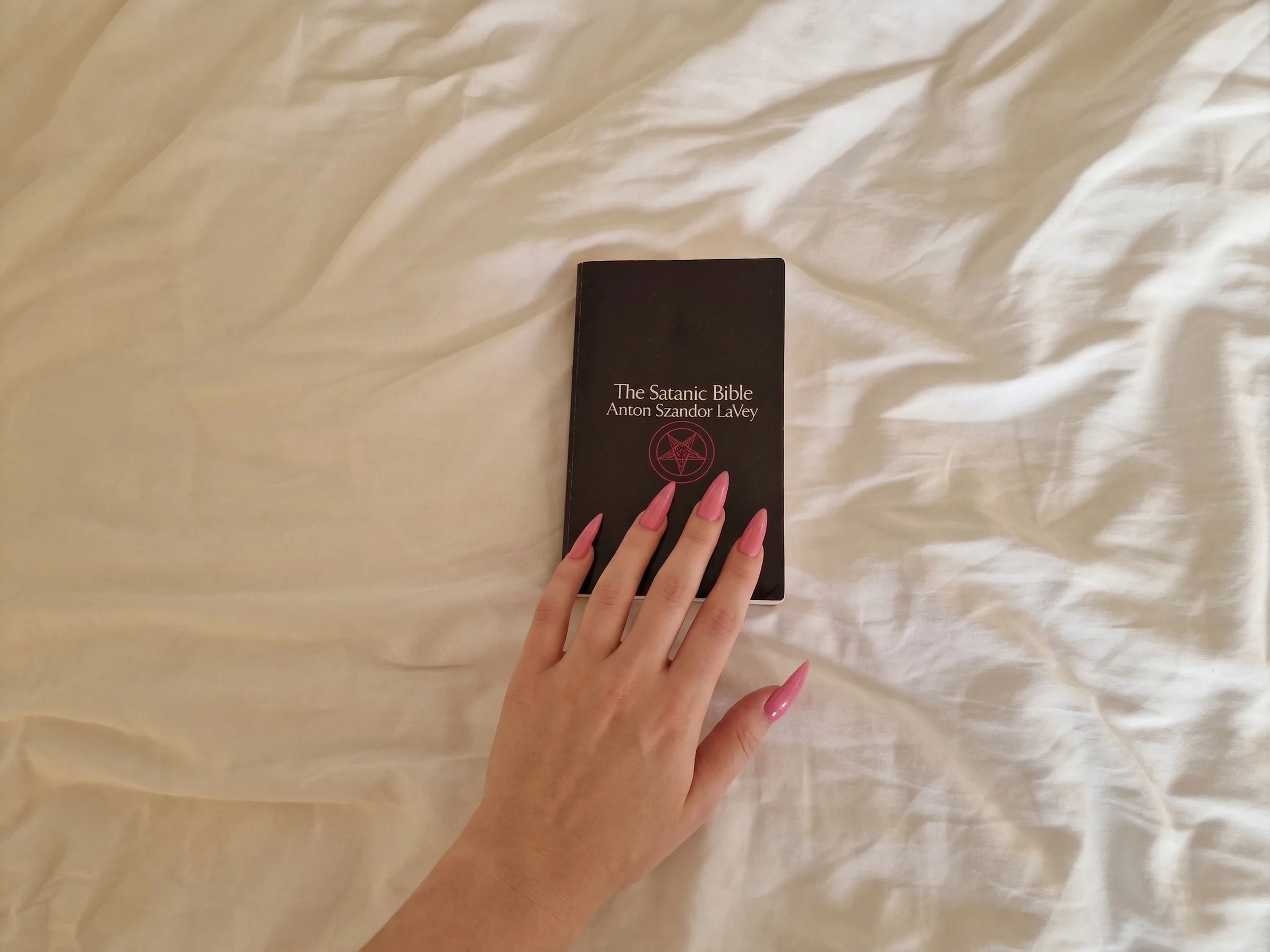
LaVey's core argument is simple: you are your own god. Your body is not shameful. Your desires are not sins. Your pleasure is not a crime. The only "sin" in LaVeyan Satanism is stupidity — and its close cousin, pretentious self-deceit.
There's no worship of a literal Devil. There's no supernatural element at all. It's atheistic humanism in a leather jacket — and that's precisely why it terrifies people. Not because it's evil, but because it removes the one thing organized religion depends on:
Guilt.
Without guilt, you can't sell salvation. Without sin, you can't sell forgiveness. Without fear of Hell, you can't fill pews. The entire economy of mainstream religion collapses the moment someone says: "My body is mine, my choices are mine, and I don't owe you an apology for existing."
That's what LaVey said. That's what industrial metal sounds like.
IV. The Honesty Problem
Here's where it gets personal.
I grew up in the Orthodox Church. My grandmother — the woman I loved more than anyone on this planet — took me every Sunday. I know the smell of frankincense the way other people know their mother's perfume. I know the liturgy by heart. I can still sing "Херувимскую" if you give me enough wine and a dark enough room.
And I loved it. Genuinely. The beauty of it — the icons, the chanting, the golden light through incense smoke. Orthodox Christianity is aesthetically magnificent.
But here's what it also taught me:
- My body is a source of temptation. (I was twelve. I had acne. I already hated my body. Thanks for the reinforcement.)
- My desires make me impure. (I was fourteen. I'd just discovered I had desires. They felt like the first real thing in my life.)
- Suffering is virtuous. (I was fifteen. I was suffering. It wasn't virtuous. It was just pain.)
- A good woman is modest, quiet, and obedient. (I was never going to be any of those things.)
Now compare this to the first time I heard Tarja Turunen's voice soar over a Nightwish symphony. Or the first time Rammstein's "Mutter" made my sternum vibrate. Or the first time I listened to Elodia in its entirety, in the dark, and felt like someone had finally described the inside of my chest.
The church told me to be small. The music told me to be enormous.
The church said: deny yourself.
The music said: become yourself.
Which one sounds like salvation to you?
V. The Devil's Greatest Trick
You know the old line — "The Devil's greatest trick was convincing the world he didn't exist." Cute. Overquoted. Wrong.
The Devil's greatest trick was being more honest than God.
Not the real God — if there is one, She's probably exhausted by Her fanbase. I mean the institutional God. The God of televangelists and conversion therapy. The God invoked to justify wars, to control women's bodies, to shame queer kids into silence, to make billions of dollars tax-free while preaching poverty.
That God has a PR problem. And no amount of contemporary worship with acoustic guitars and LED screens is going to fix it.
Meanwhile, the Devil — as a symbol, as a literary figure, as a philosophical stance — simply says: "Think for yourself. Own your body. Question authority. And if the music makes you feel something, it's not a sin. It's proof you're alive."
VI. Why Industrial Metal Is the Most Honest Genre Alive
Trent Reznor didn't put on a costume to scream about self-destruction. He was self-destructing. The Downward Spiral is a suicide note that accidentally became art. There is zero distance between the man and the sound.
Rammstein doesn't write about fire metaphorically. They literally set themselves on fire on stage. When Till Lindemann sings "Ich tu dir weh" — I hurt you — he's not performing darkness. He's investigating it. With a flamethrower.
Marilyn Manson — whatever you think of the man today — understood in the 1990s that America's real religion was fear, and he made himself into the thing they feared most. Antichrist Superstar isn't an album. It's a mirror held up to a culture that preaches love and practices exclusion.
This is what industrial metal does better than any sermon: it tells the truth about the human condition without flinching. It doesn't promise you'll be okay. It doesn't offer a ten-step plan to inner peace. It sits in the dirt with you and makes the dirt sound magnificent.
And that — that raw, uncut, unbaptized honesty — is why the Devil got the best music.
VII. A Confession (Of Sorts)
I keep a Satanic Bible on my bookshelf. It sits next to Milton. And somewhere nearby, in a small box, there's something else — something I don't talk about. Something from another life.
People think these things contradict each other. I think they're the most honest thing in my apartment.
Because here's the real secret, the one that neither the church nor the temple of Satan will tell you:
The sacred and the profane are the same thing, looked at from different angles.

A choir can make me cry. A blast beat can make me cry. An orgasm and a prayer use the same muscles in the throat. The ecstasy of a saint and the ecstasy of a sinner are neurologically indistinguishable. The body doesn't know the difference. Only the guilt does.
Remove the guilt, and all you have left is a human being, overwhelmed by being alive, reaching for something bigger than themselves.
Some reach up. Some reach down. I reach for the microphone.
VIII. The Freedom Frequency
So why does the Devil get the best music?
Because freedom is loud. It has to be. Oppression is quiet — it works best when nobody notices. Control is a whisper: don't wear that, don't say that, don't feel that, don't be that.
Freedom is a scream. A distorted guitar. A kick drum at 160 BPM. A woman in a corset singing about Satan on her birthday — not because she worships evil, but because she refuses to worship silence.
God didn't lose the music. His managers did — the moment they decided the music should make people obedient instead of alive.
The Devil didn't win the music. He just never asked it to be anything other than what it was.
And that, my darlings, is the only gospel I'll ever preach.
Ave Satanas. And turn it up. 🖤😈